Impact of eight widely consumed antibiotics on the growth and physiological profile of natural soil microbial communities
Pino-Otín, María Rosa ; Ferrando, Natalia ; Ballestero, Diego ; Langa, Elisa ; Roig, Francisco J. ; Terrado, Eva M. (Universidad de Zaragoza)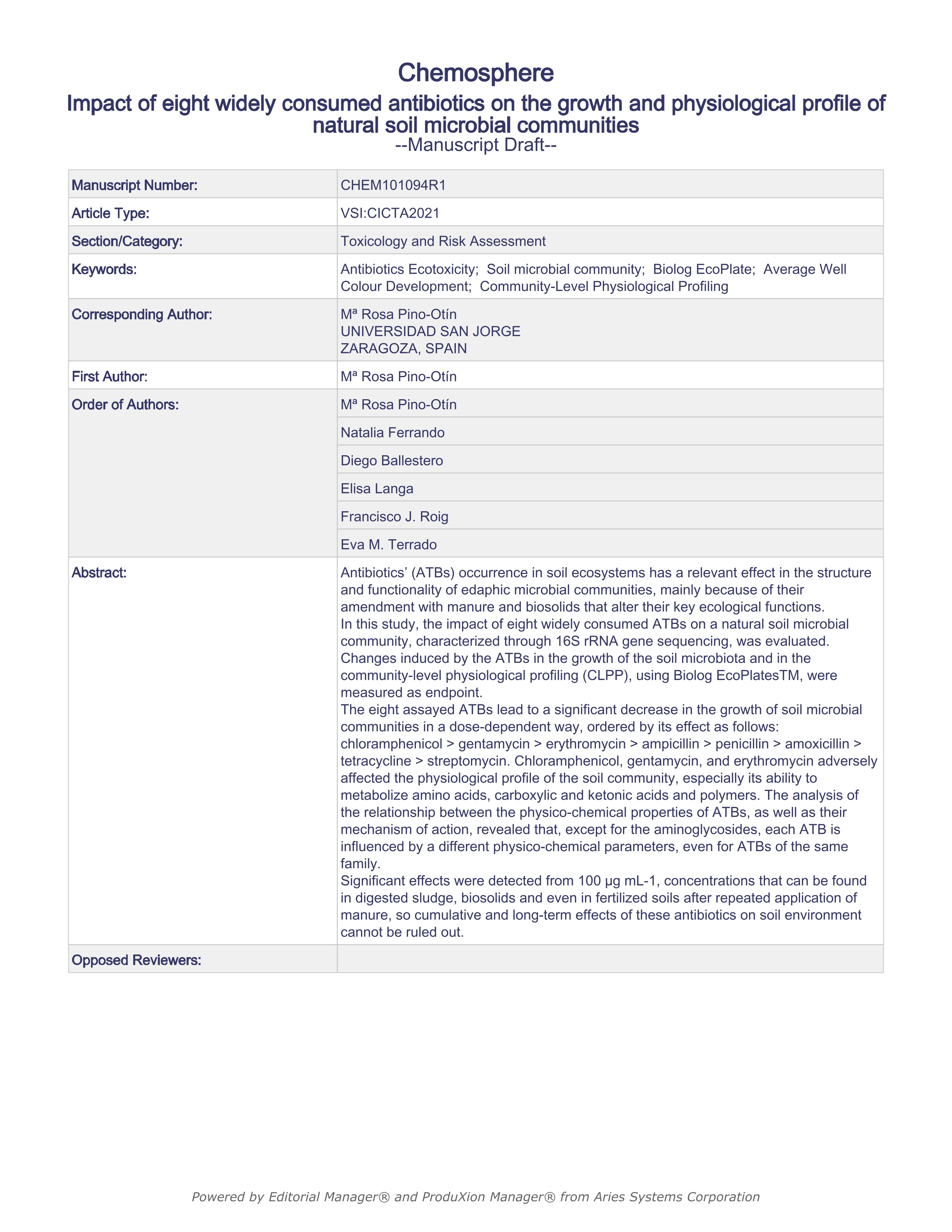
Resumen: Antibiotics’ (ATBs) occurrence in soil ecosystems has a relevant effect in the structure and functionality of edaphic microbial communities, mainly because of their amendment with manure and biosolids that alter their key ecological functions.
In this study, the impact of eight widely consumed ATBs on a natural soil microbial community, characterized through 16 S rRNA gene sequencing, was evaluated. Changes induced by the ATBs in the growth of the soil microbiota and in the community-level physiological profiling (CLPP), using Biolog EcoPlates™, were measured as endpoint.
The eight assayed ATBs lead to a significant decrease in the growth of soil microbial communities in a dose-dependent way, ordered by its effect as follows: chloramphenicol > gentamycin > erythromycin > ampicillin > penicillin > amoxicillin > tetracycline > streptomycin. Chloramphenicol, gentamycin, and erythromycin adversely affected the physiological profile of the soil community, especially its ability to metabolize amino acids, carboxylic and ketonic acids and polymers. The analysis of the relationship between the physico-chemical properties of ATBs, as well as their mechanism of action, revealed that, except for the aminoglycosides, each ATB is influenced by a different physico-chemical parameters, even for ATBs of the same family.
Significant effects were detected from 100 μg mL to 1, concentrations that can be found in digested sludge, biosolids and even in fertilized soils after repeated application of manure, so cumulative and long-term effects of these antibiotics on soil environment cannot be ruled out.
Idioma: Inglés
DOI: 10.1016/j.chemosphere.2022.135473
Año: 2022
Publicado en: CHEMOSPHERE 305 (2022), 135473 [12 pp]
ISSN: 0045-6535
Factor impacto JCR: 8.8 (2022)
Categ. JCR: ENVIRONMENTAL SCIENCES rank: 30 / 275 = 0.109 (2022) - Q1 - T1
Factor impacto CITESCORE: 13.3 - Environmental Science (Q1) - Chemistry (Q1) - Medicine (Q1)
Factor impacto SCIMAGO: 1.727 - Chemistry (miscellaneous) (Q1) - Environmental Chemistry (Q1) - Environmental Engineering (Q1) - Public Health, Environmental and Occupational Health (Q1) - Medicine (miscellaneous) (Q1) - Pollution (Q1) - Health, Toxicology and Mutagenesis (Q1)
Financiación: info:eu-repo/grantAgreement/ES/DGA/E39-20R
Tipo y forma: Article (PostPrint)
Área (Departamento): Área Didáctica Ciencias Exper. (Dpto. Didácticas Específicas)
 You must give appropriate credit, provide a link to the license, and indicate if changes were made. You may do so in any reasonable manner, but not in any way that suggests the licensor endorses you or your use. You may not use the material for commercial purposes. If you remix, transform, or build upon the material, you may not distribute the modified material.
Exportado de SIDERAL (2026-01-19-14:38:54)
Visitas y descargas
In this study, the impact of eight widely consumed ATBs on a natural soil microbial community, characterized through 16 S rRNA gene sequencing, was evaluated. Changes induced by the ATBs in the growth of the soil microbiota and in the community-level physiological profiling (CLPP), using Biolog EcoPlates™, were measured as endpoint.
The eight assayed ATBs lead to a significant decrease in the growth of soil microbial communities in a dose-dependent way, ordered by its effect as follows: chloramphenicol > gentamycin > erythromycin > ampicillin > penicillin > amoxicillin > tetracycline > streptomycin. Chloramphenicol, gentamycin, and erythromycin adversely affected the physiological profile of the soil community, especially its ability to metabolize amino acids, carboxylic and ketonic acids and polymers. The analysis of the relationship between the physico-chemical properties of ATBs, as well as their mechanism of action, revealed that, except for the aminoglycosides, each ATB is influenced by a different physico-chemical parameters, even for ATBs of the same family.
Significant effects were detected from 100 μg mL to 1, concentrations that can be found in digested sludge, biosolids and even in fertilized soils after repeated application of manure, so cumulative and long-term effects of these antibiotics on soil environment cannot be ruled out.
Idioma: Inglés
DOI: 10.1016/j.chemosphere.2022.135473
Año: 2022
Publicado en: CHEMOSPHERE 305 (2022), 135473 [12 pp]
ISSN: 0045-6535
Factor impacto JCR: 8.8 (2022)
Categ. JCR: ENVIRONMENTAL SCIENCES rank: 30 / 275 = 0.109 (2022) - Q1 - T1
Factor impacto CITESCORE: 13.3 - Environmental Science (Q1) - Chemistry (Q1) - Medicine (Q1)
Factor impacto SCIMAGO: 1.727 - Chemistry (miscellaneous) (Q1) - Environmental Chemistry (Q1) - Environmental Engineering (Q1) - Public Health, Environmental and Occupational Health (Q1) - Medicine (miscellaneous) (Q1) - Pollution (Q1) - Health, Toxicology and Mutagenesis (Q1)
Financiación: info:eu-repo/grantAgreement/ES/DGA/E39-20R
Tipo y forma: Article (PostPrint)
Área (Departamento): Área Didáctica Ciencias Exper. (Dpto. Didácticas Específicas)
You must give appropriate credit, provide a link to the license, and indicate if changes were made. You may do so in any reasonable manner, but not in any way that suggests the licensor endorses you or your use. You may not use the material for commercial purposes. If you remix, transform, or build upon the material, you may not distribute the modified material. Exportado de SIDERAL (2026-01-19-14:38:54)
Permalink:
Visitas y descargas
Este artículo se encuentra en las siguientes colecciones:
Articles > Artículos por área > Didáctica de las Ciencias Experimentales
Record created 2026-01-19, last modified 2026-01-19