Diet and Lifestyle in Nonalcoholic Fatty Liver Disease
Martínez-Beamonte, R. (Universidad de Zaragoza) ; Acín, S. ; Ramírez-Torres, A. ; Navarro, M.A. (Universidad de Zaragoza)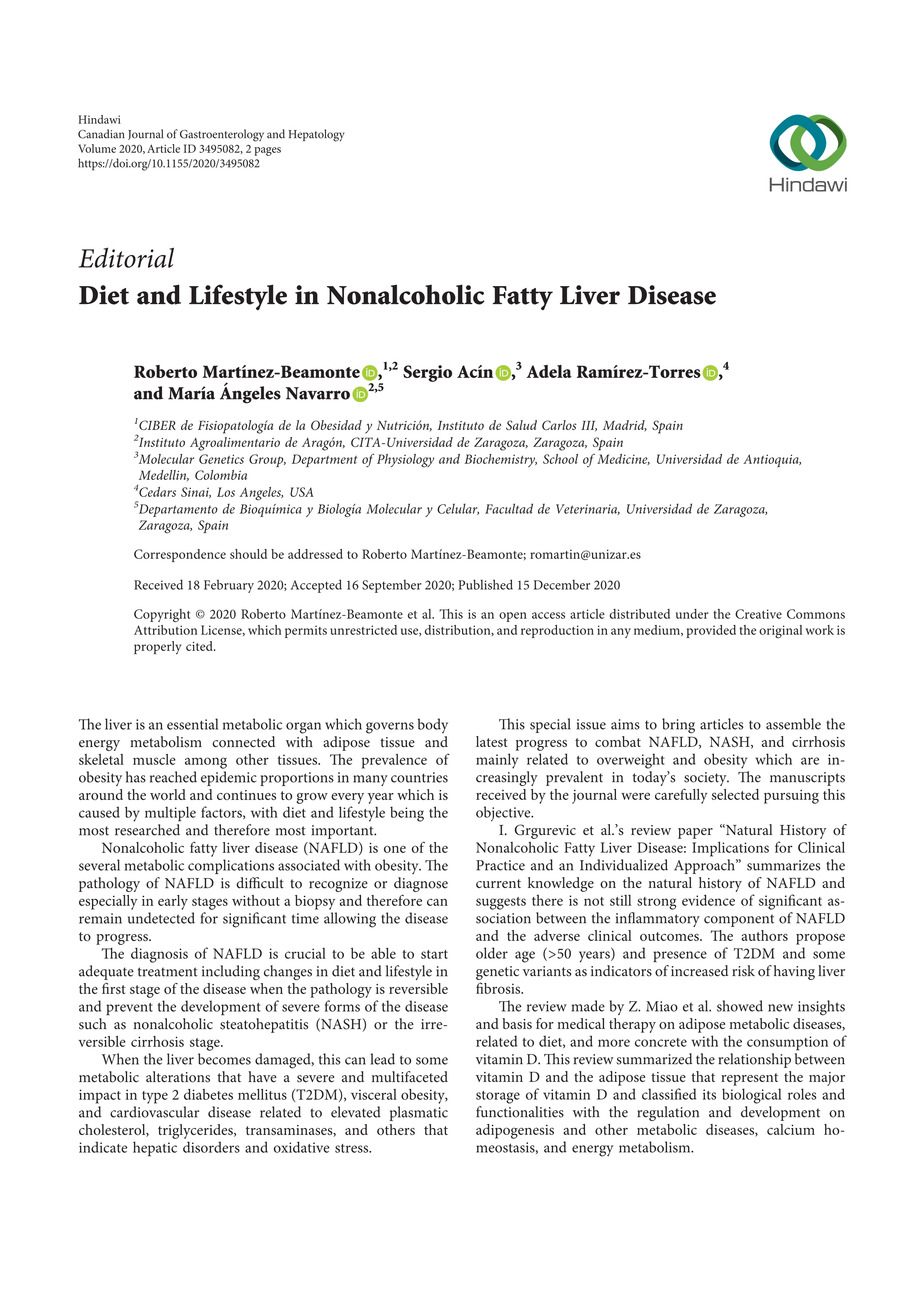
Resumen: The liver is an essential metabolic organ which governs body energy metabolism connected with adipose tissue and skeletal muscle among other tissues. The prevalence of obesity has reached epidemic proportions in many countries around the world and continues to grow every year which is caused by multiple factors, with diet and lifestyle being the most researched and therefore most important.
Nonalcoholic fatty liver disease (NAFLD) is one of the several metabolic complications associated with obesity. The pathology of NAFLD is difficult to recognize or diagnose especially in early stages without a biopsy and therefore can remain undetected for significant time allowing the disease to progress.
The diagnosis of NAFLD is crucial to be able to start adequate treatment including changes in diet and lifestyle in the first stage of the disease when the pathology is reversible and prevent the development of severe forms of the disease such as nonalcoholic steatohepatitis (NASH) or the irreversible cirrhosis stage.
When the liver becomes damaged, this can lead to some metabolic alterations that have a severe and multifaceted impact in type 2 diabetes mellitus (T2DM), visceral obesity, and cardiovascular disease related to elevated plasmatic cholesterol, triglycerides, transaminases, and others that indicate hepatic disorders and oxidative stress. ...
Idioma: Inglés
DOI: 10.1155/2020/3495082
Año: 2020
Publicado en: Canadian Journal of Gastroenterology and Hepatology 2020 (2020), 3495082 [2 pp]
ISSN: 2291-2789
Factor impacto JCR: 3.522 (2020)
Categ. JCR: GASTROENTEROLOGY & HEPATOLOGY rank: 57 / 92 = 0.62 (2020) - Q3 - T2
Factor impacto SCIMAGO: 0.921 - Gastroenterology (Q2) - Medicine (miscellaneous) (Q2) - Hepatology (Q2)
Tipo y forma: (Published version)
Área (Departamento): Área Nutrición Bromatología (Dpto. Produc.Animal Cienc.Ali.)
Área (Departamento): Área Bioquímica y Biolog.Mole. (Dpto. Bioq.Biolog.Mol. Celular)
Exportado de SIDERAL (2024-01-18-09:11:26)
Visitas y descargas
Nonalcoholic fatty liver disease (NAFLD) is one of the several metabolic complications associated with obesity. The pathology of NAFLD is difficult to recognize or diagnose especially in early stages without a biopsy and therefore can remain undetected for significant time allowing the disease to progress.
The diagnosis of NAFLD is crucial to be able to start adequate treatment including changes in diet and lifestyle in the first stage of the disease when the pathology is reversible and prevent the development of severe forms of the disease such as nonalcoholic steatohepatitis (NASH) or the irreversible cirrhosis stage.
When the liver becomes damaged, this can lead to some metabolic alterations that have a severe and multifaceted impact in type 2 diabetes mellitus (T2DM), visceral obesity, and cardiovascular disease related to elevated plasmatic cholesterol, triglycerides, transaminases, and others that indicate hepatic disorders and oxidative stress. ...
Idioma: Inglés
DOI: 10.1155/2020/3495082
Año: 2020
Publicado en: Canadian Journal of Gastroenterology and Hepatology 2020 (2020), 3495082 [2 pp]
ISSN: 2291-2789
Factor impacto JCR: 3.522 (2020)
Categ. JCR: GASTROENTEROLOGY & HEPATOLOGY rank: 57 / 92 = 0.62 (2020) - Q3 - T2
Factor impacto SCIMAGO: 0.921 - Gastroenterology (Q2) - Medicine (miscellaneous) (Q2) - Hepatology (Q2)
Tipo y forma: (Published version)
Área (Departamento): Área Nutrición Bromatología (Dpto. Produc.Animal Cienc.Ali.)
Área (Departamento): Área Bioquímica y Biolog.Mole. (Dpto. Bioq.Biolog.Mol. Celular)
Exportado de SIDERAL (2024-01-18-09:11:26)
Permalink:
Visitas y descargas
Este artículo se encuentra en las siguientes colecciones:
articulos > articulos-por-area > bioquimica_y_biologia_molecular
articulos > articulos-por-area > nutricion_y_bromatologia
Notice créée le 2021-02-12, modifiée le 2024-01-18